Write Models,
Not Code
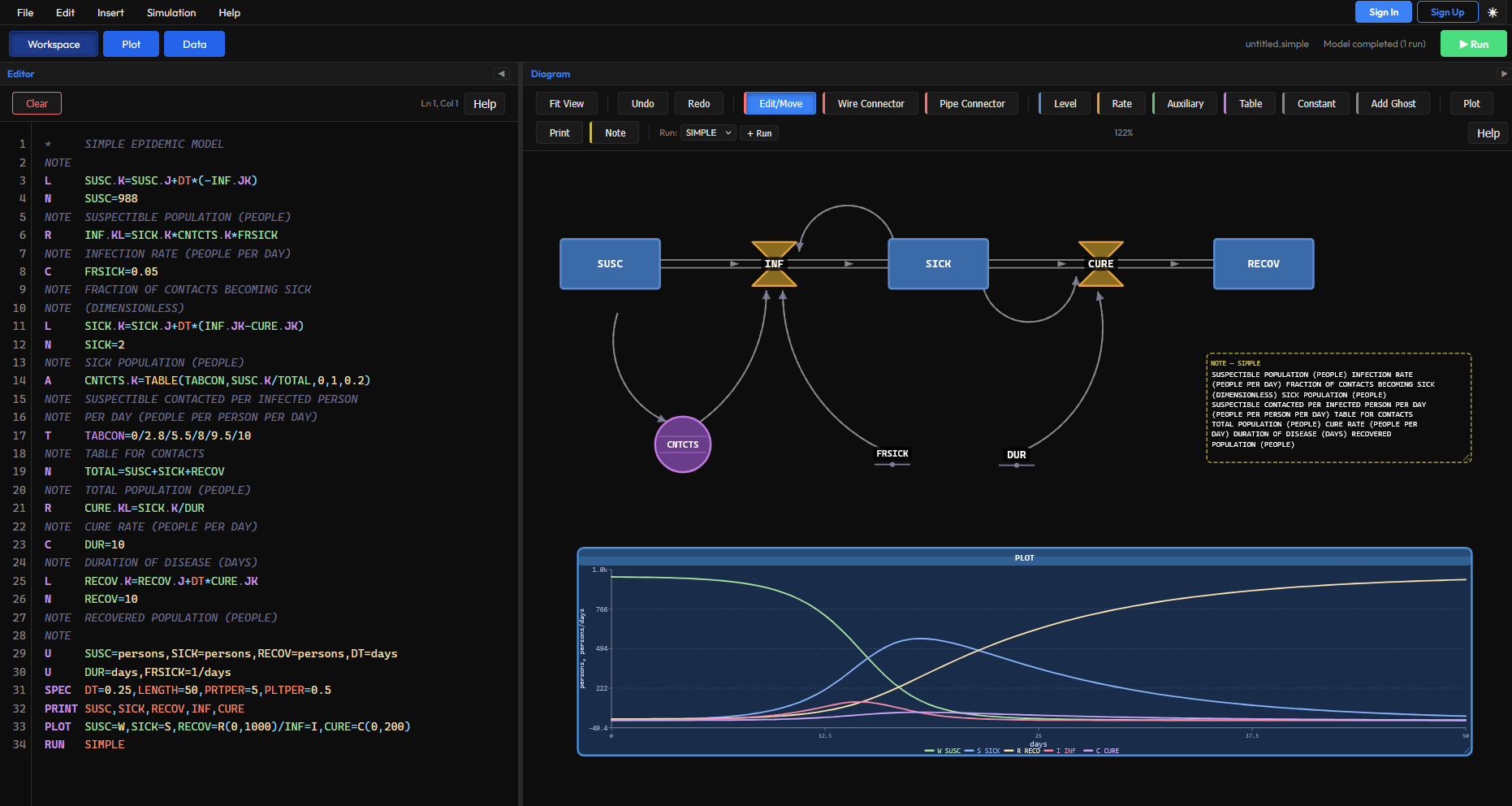
The S.I.M.P.L.E. language reads like a description of your system. Define stocks, flows, and relationships in a clear, readable format that anyone can understand.
The name itself is a nod to history. In 1958, MIT programmer Richard Bennett created a system called SIMPLE — "Simulation of Industrial Management Problems with Lots of Equations" — as a proof-of-concept for Jay Wright Forrester's industrial dynamics work. That prototype evolved into DYNAMO (DYNAmic MOdels), a dedicated simulation language developed by Dr. Phyllis Fox, Alexander L. Pugh III, Grace Duren, and others at the MIT Computation Center.
DYNAMO became the standard tool for system dynamics modeling for nearly three decades. It powered the groundbreaking resource depletion simulations behind the Club of Rome's Limits to Growth report and was applied across fields from urban planning to population studies. The language prioritized accessibility over programming expertise — letting researchers and analysts describe systems rather than write software. It progressed from mainframes to minicomputers in the late 1970s and arrived on personal computers as "micro-Dynamo" in the early 1980s, going through several revisions up to DYNAMO IV in 1983.
S.I.M.P.L.E. SD carries that same philosophy into the browser age: anyone should be able to model a dynamic system without being a programmer first.
Try It Now →